Tanzania Black Pepper: Sourcing Guide
Overview
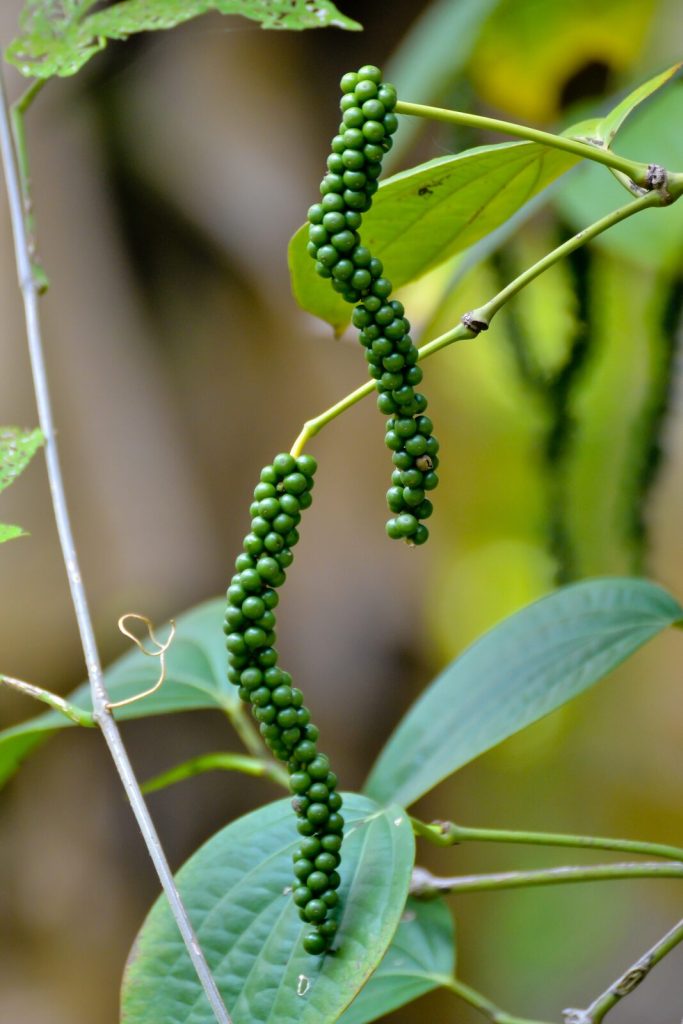
Black pepper (Piper nigrum, mainland genotypes locally named BABUKUBWA, ISMAILIA, BABUNDOGO, FUPI, NDEFU and KATI) is a real, if marginal, smallholder commercial crop in Tanzania. It is one of five spices named in Tanzania’s spice-sector development strategy alongside cloves, ginger, cinnamon and cardamom, but it has nothing close to cloves’ scale: a 2026 peer-reviewed field survey found it concentrated among smallholders citing low price, knowledge gaps and drought as their leading production constraints, not a plantation-scale export industry.
Growing Regions
Correction (2026-09-28): an earlier version of this article named Pemba Island / Zanzibar as the “best-documented” pepper-growing area, citing an EU-certified-organic cooperative and a named specialty importer. A fresh research pass, including a direct check against a peer-reviewed 2026 agricultural survey, could not independently confirm commercial black pepper cultivation on Unguja or Pemba from any government, academic, or otherwise-checkable source. That claim is retracted here rather than repeated.
The documented growing areas are both on the mainland: Morogoro Rural district (Uluguru Mountains agroecosystem) and Muheza district, Tanga Region (East Usambara Mountains) — consistent with both the 2026 academic survey and the independently-confirmed location of Trianon Spices’ own processing facility in Lusanga village, Muheza. A separate marketplace source claims smallholder sourcing from Iringa in southern Tanzania; this has no named growers or independent corroboration and is noted only as an unconfirmed claim, not fact.
Quality & Handling
A documented, Tanzania-specific quality problem: pepper is frequently harvested before full maturity or sun-dried on mats laid directly on the ground at the farm, creating a real contamination risk from dust or livestock — a 2017 field-research finding, not a historical footnote, and a concrete area where buyer-side inspection and post-harvest-handling investment could add value. (This finding predates the 2026-09-28 research pass and has not been independently re-verified against its original source in this review.)
Trade Data
ITC Trade Map data (HS 0904) for 2012–2016 shows Tanzania’s world pepper/capsicum exports rising overall, with a notable outlier: $733,000 (2012), $165,000 (2013), a $14,812,000 spike in 2014 (unexplained in the source and not corroborated elsewhere — treat as an anomaly, not a trend), $598,000 (2015), $1,201,000 (2016). Exports to the EU specifically rose more than tenfold from 2015 to 2016 ($61,000 to $770,000).
Correction (2026-09-28): an earlier version of this section cited a 2024 figure of $2.38 million in export value on 738 tonnes, attributed to an aggregator chain. A fresh attempt to verify that figure directly against its original source (OEC) returned only a page title, not the underlying data — it could not be confirmed and is removed rather than repeated with an unearned appearance of precision. In its place, here is what could be directly verified: Tridge trade-intelligence data shows Tanzanian black pepper exports of 279.94 tonnes worth $1,004,611 in 2022, and 254.56 tonnes worth $803,546 in 2023 — a year-on-year decline shown as reported, with no source found explaining it. Separately, an export unit-value (export value ÷ volume, not a domestic wholesale price) of roughly $3.23/kg was computed from UN Comtrade data as of January 2024, per Selina Wamucii.
Production estimates also conflict: 457 tonnes (2022, FAOSTAT-derived) versus 437 tonnes for an unclear “2024” figure from a different aggregator — neither reconciled against the other, both shown rather than one being silently preferred.
Processors & Exporters
Two Tanzanian spice businesses have independently-corroborated black pepper activity (not merely self-reported): Trianon Spices, a processor/exporter with a factory in Muheza sourcing from 1,000+ smallholders, whose black pepper product line and Muheza location are both confirmed directly on the company’s own site and independently corroborated by the Dutch development-finance institution Invest International (a €500,000 DGGF loan, 2023); and Horizon Spices — properly, the Tanzania operations of the multi-country aggregator Horizon Group Africa, whose black pepper handling is confirmed by two independent 2025 trade-press reports of a $5 million Aavishkaar Capital/KfW financing deal. Horizon’s own company website does not currently resolve, so this listing relies entirely on third-party press, not self-reported claims.
What We Don’t Know
We could not independently verify the 2014 export spike against a primary government or FAOSTAT source, nor reconcile the 437-tonne vs. 457-tonne production estimates, nor the earlier claim of commercial cultivation on Zanzibar/Pemba (now retracted above). Tanzania’s own spice-sector trade association is on record (The Citizen, 2019) describing the underlying problem directly: “We are scattered; every spice farmer survives on his/her own, which makes it very difficult to collect data.” These gaps are flagged rather than silently smoothed over or omitted.
Current Market
Tanzania
| Market | Type | Grade | Price | Observed | Source |
|---|---|---|---|---|---|
| Tanzania (black pepper, sampled export transactions) | Export | — | USD 8.15/kg | 6 Mar 2026 | Tridge |
| Tanzania (black pepper, export unit value) | Export unit value | — | USD 3.23/kg | 1 Jan 2024 Historical | Selina Wamucii |
| Tanzania (black pepper) | Wholesale | — | TZS 22,000.00/kg | 1 Jan 2016 Historical | TASPA |
International Benchmark
Reference prices from outside Tanzania — shown for market context, not as a price a Tanzanian seller or buyer can obtain.
| Market | Type | Grade | Price | Observed | Source |
|---|---|---|---|---|---|
| IPC indicator price -- Brazil Black Pepper ASTA 570 | Indicative | Brazil Black Pepper ASTA 570 | USD 6,000.00/tonne | 13 Feb 2026 | International Pepper Community |
| IPC indicator price -- Indonesia Black Pepper | Indicative | Indonesia Black Pepper | USD 6,848.00/tonne | 13 Feb 2026 | International Pepper Community |
| IPC indicator price -- Indonesia White Pepper | Indicative | Indonesia White Pepper | USD 9,270.00/tonne | 13 Feb 2026 | International Pepper Community |
| IPC indicator price -- Malaysia Black Pepper ASTA | Indicative | Malaysia Black Pepper ASTA | USD 9,100.00/tonne | 13 Feb 2026 | International Pepper Community |
| IPC indicator price -- Malaysia White Pepper ASTA | Indicative | Malaysia White Pepper ASTA | USD 12,100.00/tonne | 13 Feb 2026 | International Pepper Community |
| IPC indicator price -- Vietnam Black Pepper 500 g/l | Indicative | Vietnam Black Pepper 500 g/l | USD 6,400.00/tonne | 13 Feb 2026 | International Pepper Community |
| IPC indicator price -- Vietnam Black Pepper 550 g/l | Indicative | Vietnam Black Pepper 550 g/l | USD 6,600.00/tonne | 13 Feb 2026 | International Pepper Community |
| IPC indicator price -- Vietnam White Pepper | Indicative | Vietnam White Pepper | USD 9,150.00/tonne | 13 Feb 2026 | International Pepper Community |
| IPC indicator price -- India Black Pepper | Indicative | India Black Pepper | USD 7,924.00/tonne | 12 Feb 2026 | International Pepper Community |
| New York spot price (IPC benchmark) | Benchmark | black | USD 7,840.00/tonne | 1 Dec 2024 | International Pepper Community |
| New York spot price (IPC benchmark) | Benchmark | white | USD 9,675.00/tonne | 1 Dec 2024 | International Pepper Community |
Production & Trade
| Category | Value | Period | Geography | Source |
|---|---|---|---|---|
| Area Harvested | 983 ha | 2024 | National | FAOSTAT (Food and Agriculture Organization of the UN) |
| Area Harvested | 987 ha | 2023 | National | FAOSTAT (Food and Agriculture Organization of the UN) |
| Area Harvested | 991 ha | 2022 | National | FAOSTAT (Food and Agriculture Organization of the UN) |
| Area Harvested | 997 ha | 2021 | National | FAOSTAT (Food and Agriculture Organization of the UN) |
| Area Harvested | 917 ha | 2020 | National | FAOSTAT (Food and Agriculture Organization of the UN) |
| Area Harvested | 939 ha | 2019 | National | FAOSTAT (Food and Agriculture Organization of the UN) |
| Area Harvested | 972 ha | 2018 | National | FAOSTAT (Food and Agriculture Organization of the UN) |
| Area Harvested | 939 ha | 2017 | National | FAOSTAT (Food and Agriculture Organization of the UN) |
Figures from different sources sometimes disagree (e.g. sector-body press statements vs. customs trade data) — where that happens we show both, tagged by source, rather than silently picking one. See Data Sources.
Suppliers
5 publicly-sourced suppliers for this commodity — producers, processors, exporters and cooperatives.

Trianon Spices
Spice processor and exporter with a factory in Muheza, Tanga Region, sourcing from 1,000+ smallholder farmers…
Ubora Landmark Limited
Organic black pepper exporter and bulk spice supplier sourcing from Tanga and Morogoro regions; also handles…
Horizon Spices Limited
Tanzania operations of Horizon Group, a multinational spice-aggregation company founded 2006 in Nigeria that pivoted into…
Kili Quality
Moshi-based trader sourcing sesame from Lindi, Mtwara and Singida (and Ghana); states Tanzanian sesame is valued…
Agripromise Co. Ltd (Linda Spices)
Spice producer sourcing black pepper, cinnamon and other spices from smallholder farmers in Morogoro Region's Uluguru…
Tanzania Commodities Marketplace — Buy & Sell Black Pepper
Verified seller companies, buying requirements and direct quotations for Black Pepper — powered by the network's shared B2B marketplace.
Available Offers
No active Black Pepper offers are currently published.
Are you a Tanzanian Black Pepper supplier? List your product.
Buyer Requirements
No open Black Pepper buying requirements right now.
Looking to buy? Post a buying requirement.
- REPOA Policy Brief PB 3/2018 — Harnessing the potential of Tanzania's exports competitiveness for spices — https://www.repoa.or.tz/wp-content/uploads/2020/07/Harnessing_the_potential_of_Tanzanias_exports.pdf — 2026-09-25
- Kayala, Chilagane & Majubwa (2026) — Distribution, Indigenous Knowledge, Seed System and Production Constraints of Black Pepper — East African Journal of Agriculture and Biotechnology — https://journals.eanso.org/index.php/eajab/article/view/5643 — 2026-09-28
- Tridge — Tanzania Black Pepper Supplier/Market Intelligence — https://www.tridge.com/intelligences/black-pepper/TZ/supplier — 2026-09-28
- Selina Wamucii — Tanzania Pepper Prices — https://www.selinawamucii.com/insights/prices/tanzania/pepper/ — 2026-09-28
- World Population Review (FAOSTAT) — Black Pepper Production by Country — https://worldpopulationreview.com/country-rankings/black-pepper-production-by-country — 2026-09-28
- Invest International (DGGF) — Trianon Spices, Tanzania — https://investinternational.nl/news-items/trianon-spices-tanzania-sustainable-and-profitable-for-farmers-and-business/ — 2026-09-28
- Food Business Middle East & Africa / African Business (2025) — Horizon Group Africa $5M loan coverage — 2026-09-28
- The Citizen (Tanzania, 2019) — Tanzania spice exports low (TASPA data-collection quote) — https://www.thecitizen.co.tz/news/business/Tanzania-spice-exports-low/1840414-5057002-cbq6b2z/index.html — 2026-09-28